

How Much Is a Drop in mL? Precision and Variations with Cosmetic Droppers
If you are asking how much is a drop in mL, the most common reference figure is approximately 0.05 mL per drop, equivalent to around 20 drops per millilitre.
But for cosmetic packaging, that number should be treated as a reference rather than a rule.
A drop is not a fixed unit of volume. Its actual size depends on the liquid being dispensed, the design of the dropper, the geometry of the outlet and even the way the consumer uses the pack. A lightweight water-based serum, a facial oil and a more viscous treatment can all produce different drops from apparently similar dispensing systems.
The 0.05 mL figure comes from a conventional medicine-dropper reference based on water under defined conditions. Pharmacopoeial guidance itself acknowledges that liquids with different viscosity and surface tension characteristics produce different drop sizes.
For cosmetic brands, the more useful question is therefore not simply how much is a drop?
It is:
How much is a drop of this specific formula when dispensed through this specific cosmetic dropper?
That distinction is fundamental when precision, dosage and consumer experience matter.
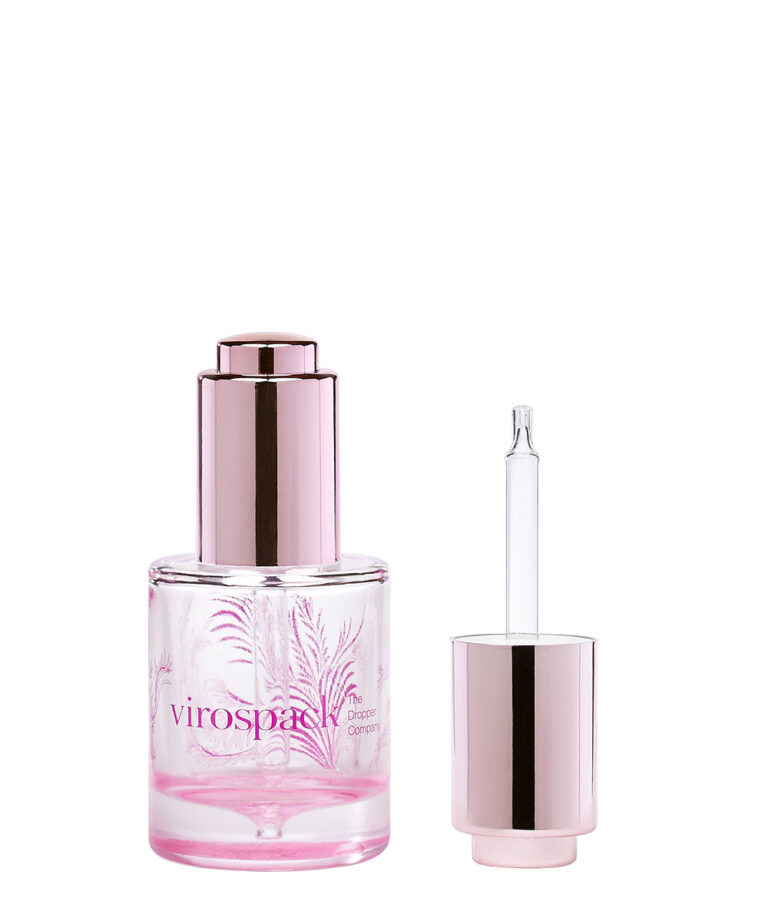
Table of Contents
How Much Is a Drop in mL?
As a general approximation:
1 drop ≈ 0.05 mL
Using that reference, 1 mL would contain approximately 20 drops.
However, empirical measurements show why this figure should not be applied automatically to cosmetic formulations. Even water dispensed through medicine droppers can produce drops below the nominal 0.05 mL value depending on factors such as the dropper and dispensing conditions. Different liquids introduce even greater variation because drop formation depends heavily on their physical properties.
In cosmetic packaging, this variability is especially important because formulas can behave very differently.
A low-viscosity serum may flow rapidly through the dropper.
An oil can wet the dispensing surface differently.
A serum containing gums, polymers or high levels of humectants may form a slower, more persistent drop before detaching.
Two products in identical 30 mL bottles therefore do not necessarily contain the same number of usable drops.
And two cosmetic droppers do not necessarily create the same drop from the same formula.
The volume of a drop belongs to the formula–dropper combination, not to the bottle volume alone.
Why a Drop Is Not a Fixed Measurement

A drop forms when liquid accumulates at the end of the dropper until it can no longer remain attached.
Its final size is determined by a balance between the forces pulling the liquid downward and the forces holding it to the dispensing surface.
This is why cosmetic drops cannot be treated like millilitres or grams.
A millilitre remains a millilitre regardless of the formula.
A drop does not.
Several characteristics interact during drop formation, including the formula’s surface tension, viscosity and density, the geometry of the dropper outlet, the way the liquid wets the dispensing surface and the speed at which it is released.
Temperature can also influence behaviour because it can change viscosity and flow.
Even the angle of use matters. A drop formed while the system is held vertically may not behave exactly like one released while the consumer holds the dropper at an angle.
For cosmetic packaging, the implication is important: drop size cannot be predicted reliably from bottle capacity or formula category alone.
It has to be evaluated with the actual dispensing system.
Formula Properties Have a Major Influence on Drop Size
It is tempting to simplify drop behaviour into a rule such as “thicker formulas create bigger drops”, but cosmetic formulations are more complicated than that.
Viscosity is important, but it is only one variable.
Surface tension determines how strongly the liquid tends to hold together at the dropper outlet. Wetting behaviour determines how the formula interacts with the material and geometry of the dispensing area. Oils, alcohol-containing solutions, aqueous serums and surfactant-rich formulas can therefore produce very different drops even when their apparent thickness seems similar.
This becomes particularly relevant with modern skincare.
A hyaluronic acid serum may have a noticeably different flow from a lightweight niacinamide formula.
A facial oil behaves differently from both.
An oil-serum emulsion introduces another set of properties.
A highly fluid essence may release very quickly unless the dropper configuration controls the flow appropriately.
This is why the formula should be tested as part of the complete pack.
The word serum tells us what category the product belongs to.
It does not tell us how large its drops will be.
Droppers Catalogue
Discover our full range of droppers catalogue
The Dropper Itself Determines How the Formula Is Released
The formula is only half of the equation.
The dropper also has a major influence on the final drop.
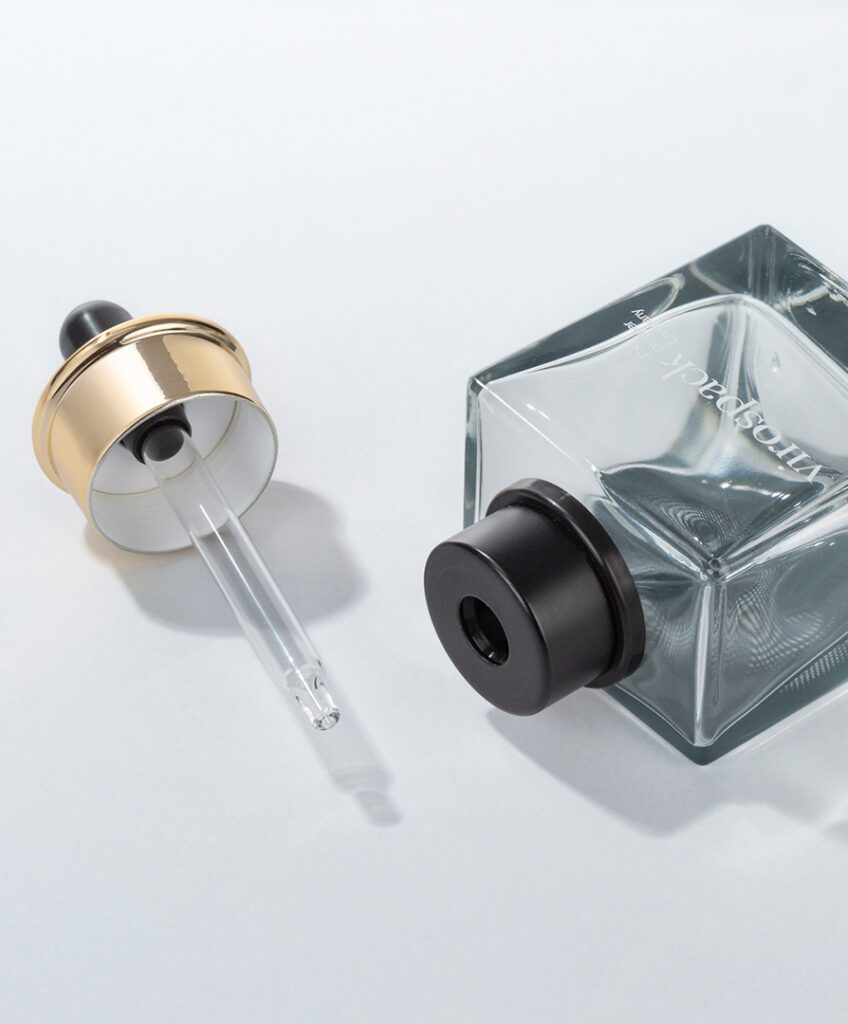
Changes in the internal and outlet geometry of the dispensing system can affect how the liquid accumulates and detaches. A different outlet dimension or tip configuration can change the relationship between the formula and the dispensing surface, producing smaller, larger or simply more consistent drops.
This is particularly important in cosmetic packaging because droppers are not all designed around the same formula or bottle.
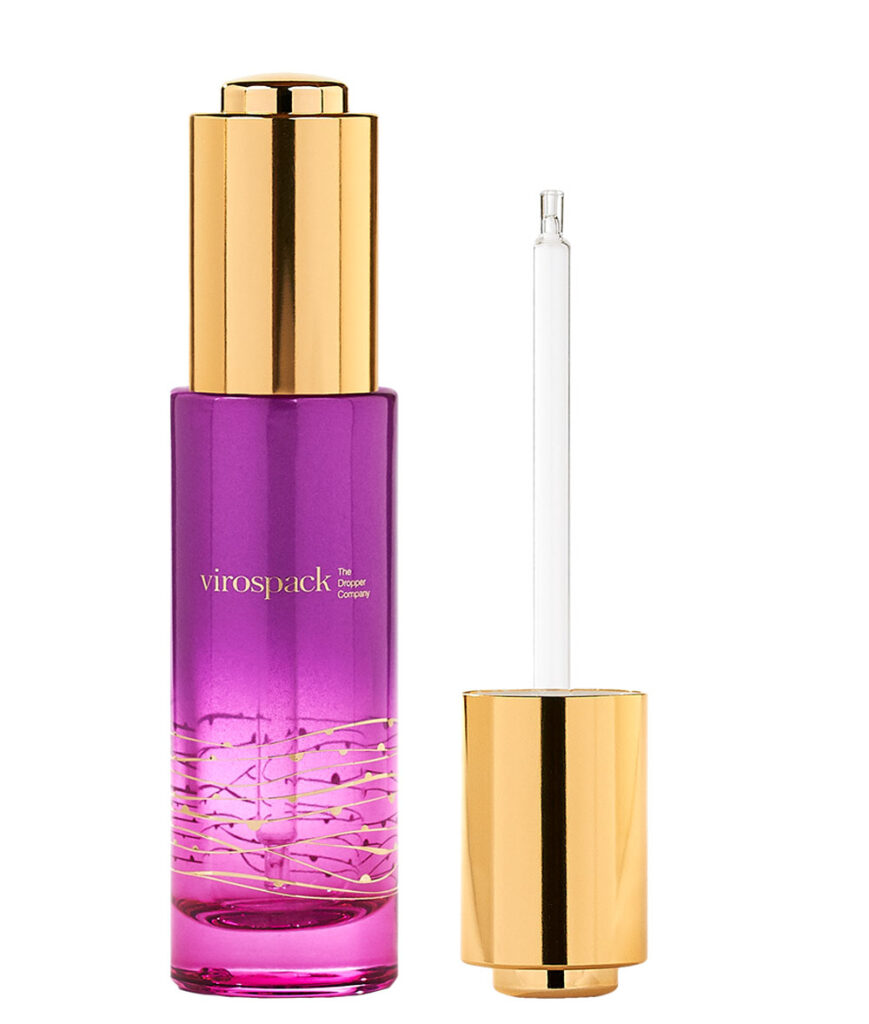
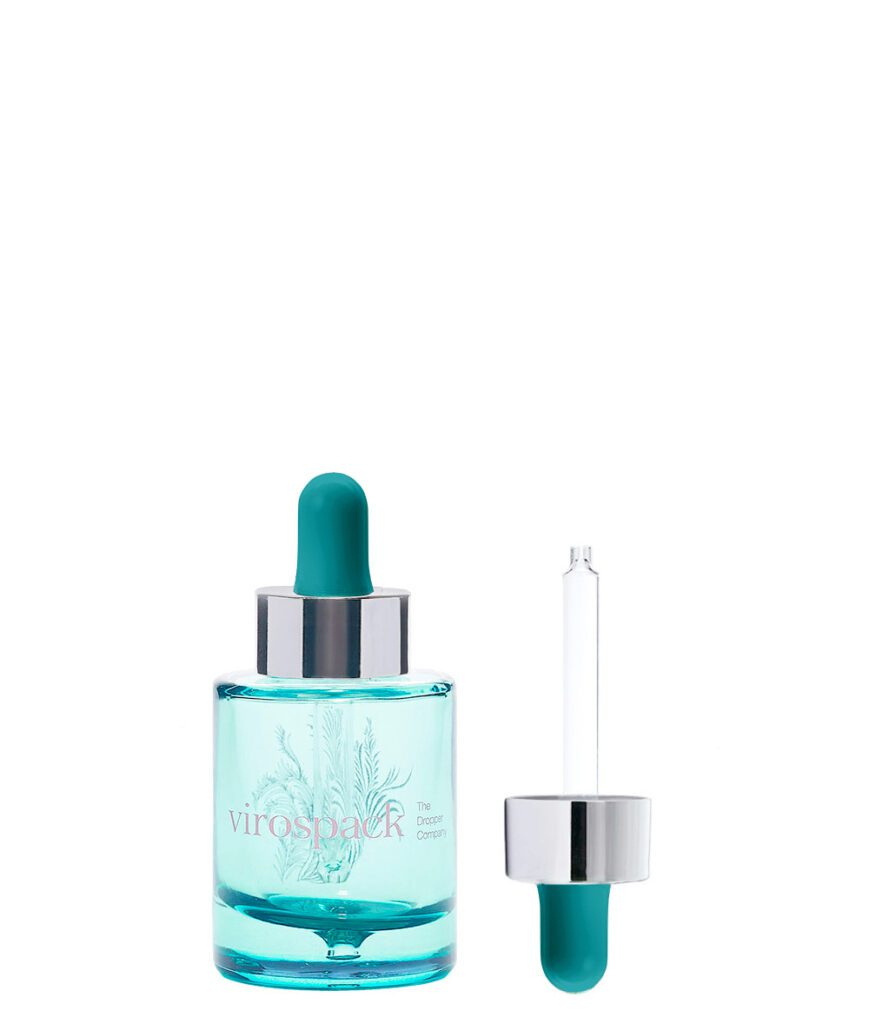
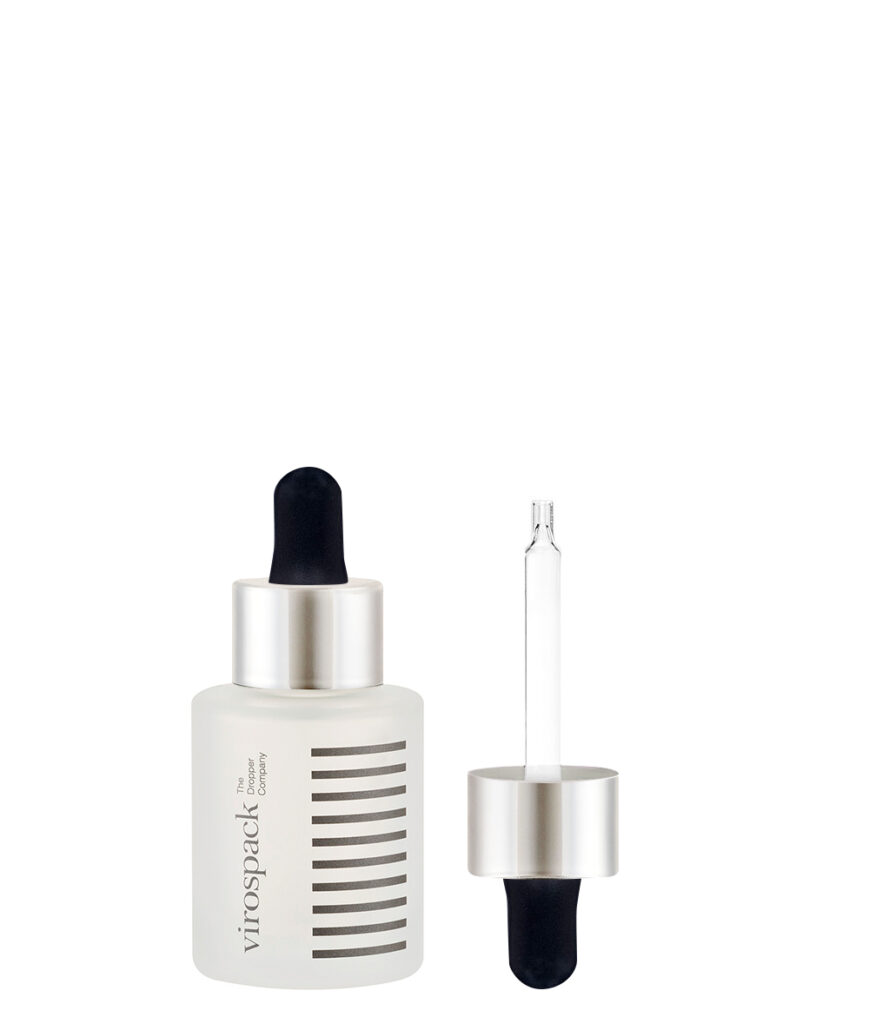
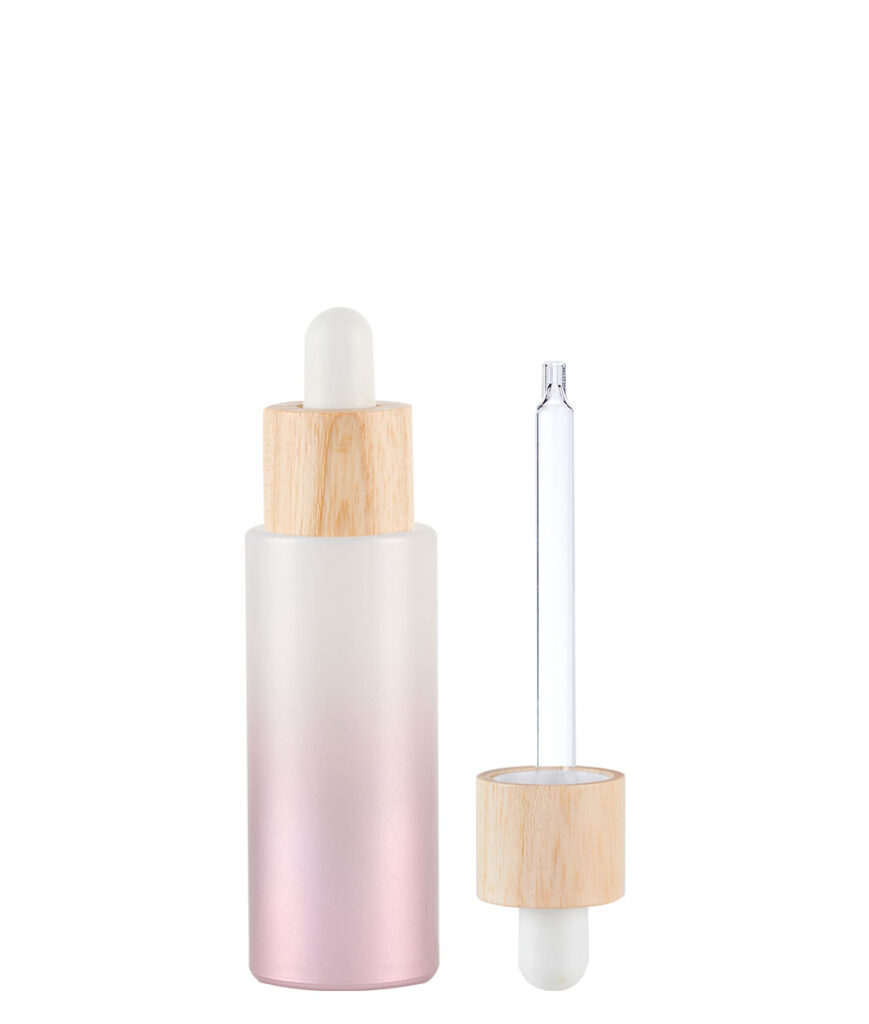
Virospack’s cosmetic dropper range, for example, includes different neck configurations, bulb volumes and dropper dimensions for different packaging requirements. Its technical ranges include smaller-volume configurations as well as systems with greater nominal capacities, depending on the dropper architecture.
These variations exist for a reason.
A dropper intended for a small concentrated treatment does not necessarily need the same configuration as one developed for a larger facial oil or fluid makeup product.
Precision therefore starts with matching the system to the formula rather than assuming that every cosmetic dropper performs identically.
Drop Size and Dropper Capacity Are Not the Same Thing
This distinction is particularly important.
When a dropper specification includes a volume in millilitres, that number should not automatically be interpreted as the volume of one drop.
A dropper can draw or contain a substantially larger volume of formula and then release that volume progressively as multiple individual drops.
For example, Virospack’s standard range includes cosmetic dropper configurations listed at nominal volumes such as 0.65 mL, while some push button configurations in its standard packs are listed around 0.35 or 0.40 mL. Those figures describe the dropper configuration, not a claim that a single cosmetic drop equals 0.35, 0.40 or 0.65 mL.
This is where confusion often arises.
There are really two different questions:
How much formula can the dropper draw or dispense during an actuation?
and
How much formula is contained in each individual drop leaving the system?
They are not interchangeable measurements.
For cosmetic brands developing dosage instructions such as “apply three drops”, it is the second question that matters.
Standard Droppers Give Consumers Flexible Control
A standard cosmetic dropper works particularly well when the consumer should control the amount of formula according to the routine.
The bulb is compressed, the formula is drawn into the system and the user then releases the liquid progressively.
This makes the format particularly natural for facial serums, oils, boosters and other treatments where dosage does not necessarily need to be identical at every application.
One consumer may apply three drops to the face.
Another may use additional product on the neck.
The same consumer may change the amount according to season, layering or skin condition.
The standard dropper supports this flexibility.
But flexible dosing does not mean uncontrolled dispensing.
A well-developed dropper should produce a predictable flow and reasonably consistent drop formation with the intended formula. If some drops are extremely small while others release as large beads or short streams, the consumer loses confidence in the dosage.
The goal is therefore not necessarily to make every drop mathematically identical.
It is to make dispensing sufficiently consistent that the consumer understands how the product behaves.
Push Button Droppers Change the Meaning of Precision
Push button droppers introduce a different type of control.
Instead of relying entirely on the consumer’s manual compression of a conventional bulb, the actuator creates a more defined dispensing gesture. This can make the overall quantity drawn or released during use feel more repeatable.
For concentrated skincare, boosters and other high-value formulas, this can reinforce the perception of technical precision.
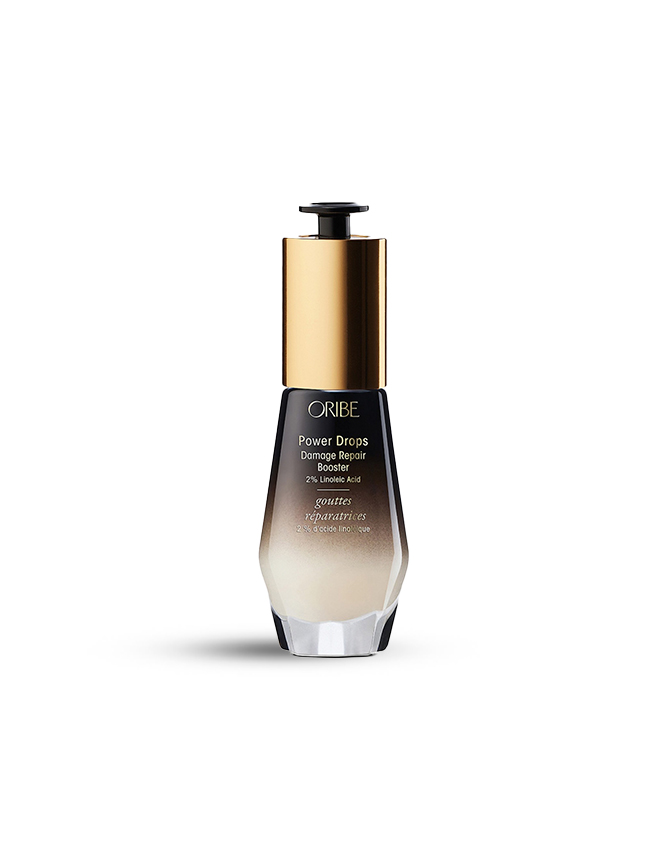
Virospack develops push button droppers specifically around controlled cosmetic dispensing, including systems designed for serums, oils and targeted treatments.
However, a push button mechanism does not suddenly make the physical volume of an individual drop universal.
The formula still matters.
The geometry of the dropper still matters.
Drop formation still depends on how the liquid behaves at the outlet.
What the push button can improve is the repeatability of the dispensing gesture and the volume handled by the system, which is different from claiming that every individual drop has an exact universal volume.
This distinction is important when discussing cosmetic precision honestly.
Why Drop Consistency Matters in Skincare
For many cosmetics, a slight difference in individual drop volume is not critical.
But consistency still has a major influence on the user experience.
Imagine a serum whose instructions recommend three drops.
If those three drops are reasonably consistent from one application to another, the consumer quickly develops an intuitive understanding of the product. They know how much is needed, how far it spreads and approximately how long the bottle will last.
If drop behaviour changes constantly, that relationship becomes less predictable.
The user may apply too much.
They may compensate by using fewer drops.
The bottle may appear to empty faster than expected.
The formula may also feel less refined because the dispensing system seems inconsistent.
For concentrated skincare, this becomes even more relevant. The more the product is positioned around precision, actives or controlled treatment, the more important it is that the packaging supports that positioning.
The dropper becomes part of the dosage language of the product.

Drop Consistency Also Affects Product Consumption
Drop size influences more than application.
It also affects how quickly the consumer uses the bottle.
If the average drop becomes larger, fewer drops are available from the same nominal volume. If the average drop is smaller, the same bottle can produce more individual drops.
Using the conventional 0.05 mL reference purely as an illustration, a 30 mL bottle would correspond to roughly 600 drops. But if the actual formula–dropper combination produced an average drop closer to 0.03 mL, the number would be substantially higher; at 0.07 mL, substantially lower.
That difference can affect how consumers interpret dosage instructions and product longevity.
It also explains why statements such as “a 30 mL serum contains 600 drops” should not be treated as universal facts.
They are estimates based on an assumed drop volume.
For accurate product-specific communication, the actual pack should be tested.
How to Determine the Real Volume of a Cosmetic Drop
For a beauty brand, the most useful drop volume is not a theoretical reference from another industry.
It is the measured average produced by the final formula and final dropper.
Testing should therefore reproduce the way the product is intended to be used as closely as possible.
A representative sample of finished packs can be conditioned under controlled conditions and dispensed using a defined orientation and technique. Rather than trying to measure a single tiny drop in isolation, multiple drops can be collected and measured together, allowing the average volume per drop to be calculated more reliably.
The test should then be repeated across several packs and dispensing cycles.
This matters because evaluating only one drop from one bottle says very little about consistency.
For a more complete picture, brands may also want to consider whether drop behaviour changes according to bottle fill level, storage conditions or repeated use.
The objective is not to prove that every drop is microscopically identical.
It is to understand the real dispensing behaviour of the finished product.
That information is much more valuable than relying on the generic 0.05 mL assumption.

Why Testing the Formula and Dropper Together Matters
Dropper selection should therefore be part of compatibility and functionality testing.
A dropper that performs beautifully with water may behave very differently once it is filled with the actual serum.
A formula that looks fluid in a laboratory vessel may interact differently with the finished dispensing system.
An oil can wet the dropper differently.
A viscous serum may move more slowly.
Changes in temperature can modify flow.
Long-term contact between the formula and dropper components can also affect the system in ways that are not visible during an initial demonstration.
For this reason, cosmetic dropper development should never rely solely on nominal specifications.
Specifications help define the starting point.
Testing confirms whether the system actually works.
For brands promising precision, that distinction is essential.
How Drop Size Influences Consumer Instructions
The question how much is a drop becomes especially important when the brand wants to tell consumers exactly how to use the product.
Instructions such as “apply 2–3 drops” are extremely common in skincare because they are simple and intuitive.
But they work only if the consumer can reproduce something reasonably close to what the brand considers a drop.
This does not require laboratory-level precision.
Cosmetics are not generally dosed in the same way as medicines.
However, the relationship between the instruction and the dispensing system should make sense.
If one press releases a stream rather than a drop, “three drops” becomes confusing.
If the formula produces extremely variable drops, the dosage instruction becomes less meaningful.
Packaging and communication therefore need to be developed together.
The brand should understand how its dropper behaves before deciding how consumers should describe or measure their application.
How Much Is a Drop? Use 0.05 mL as a Reference, Not a Specification
For general conversion purposes, 0.05 mL per drop remains a useful reference because it corresponds to the conventional 20-drops-per-millilitre approximation used for a defined medicine dropper and water.
For cosmetic packaging, however, that number should not be treated as a specification.
A cosmetic drop is created by an interaction between the formula, the dropper and the way the product is dispensed.
Changing any of those variables can change the result.
For this reason, the most accurate answer to how much is a drop is:
approximately 0.05 mL as a general reference, but the real volume should be measured using the actual cosmetic formula and dropper system.
For beauty brands, that variability is not a flaw.
It is a design parameter.
And controlling it is one of the ways a well-developed dropper can turn simple dispensing into a more precise and satisfying skincare experience.
Frequently Asked Questions About Cosmetic Drop Size
How much is a drop in mL?
A commonly used reference is approximately 0.05 mL per drop, equivalent to around 20 drops per millilitre. However, cosmetic drops can be smaller or larger depending on the formula, dropper design and dispensing conditions.
Is 1 mL always equal to 20 drops?
No. Twenty drops per millilitre is a conventional approximation, not a universal rule for cosmetic formulas. The real number of drops in 1 mL depends on the average drop volume produced by the specific formula and dropper.
Why do different cosmetic droppers produce different drop sizes?
Drop size is influenced by the dropper geometry as well as the viscosity, surface tension and wetting behaviour of the formula. Differences in dispensing angle and technique can also affect how a drop forms and detaches.
Do oils and serums produce the same size drops?
Not necessarily. Oils and serums can have very different viscosity and surface-tension characteristics, so they may behave differently even when used with the same dropper. The finished formula should be tested with the intended dispensing system.
Does a 0.65 mL dropper produce 0.65 mL drops?
No. A volume such as 0.65 mL in a dropper specification should not be confused with the volume of one individual drop. The dropper can contain or handle a larger quantity of formula that is then released progressively as multiple drops.
Are push button droppers more precise?
Push button droppers can make the dispensing gesture and delivered dose more repeatable, which can be valuable for concentrated serums and targeted treatments. However, the volume of each individual drop still depends on the formula and the dispensing geometry.
How can a cosmetic brand know the exact size of its drops?
The most reliable approach is to test the finished formula with the actual dropper intended for production. Multiple drops should be measured across representative packs and dispensing cycles to establish an average and evaluate consistency.