

Eco-Friendly Skincare Packaging: Options That Don't Compromise on Premium Design
Eco-friendly skincare packaging is packaging designed to reduce its environmental impact across its whole life, from the materials it is made of to how long it lasts, how much product it lets the consumer use and how easily it can be recycled or reused. For premium skincare, the strongest options today are glass bottles combined with lower-impact droppers: mono-material, PCR, bio-based or wood components, water-based decoration and designs that make refilling and recycling easy. Chosen well, none of these options requires a brand to give up the weight, clarity and finish that define a luxury pack.
This guide focuses on the design side of the question: which sustainable options are available, what each one changes in the look and feel of the pack, and how to combine them so the result feels more premium, not less.
Key takeaways
- Sustainability and premium design are no longer a trade-off: the most effective eco choices are invisible to the consumer or add to the perception of quality.
- Glass is the best starting point for premium eco-friendly skincare packaging because it is durable, protective, refillable and recyclable.
- The dropper is where most of the environmental gains are made today, through mono-material designs and PCR, bio-based or wood components.
- Fewer materials and fewer layers make a pack easier to recycle, and often more elegant.
- Reducing product waste, with well-fitted wipers and last-drop systems, is as important as the material itself.

Table of Contents
Why eco-friendly and premium no longer pull in opposite directions

For years, “sustainable packaging” in beauty was associated with a specific look: kraft paper, matte recycled plastic and rustic textures. That aesthetic worked for some natural brands, but it did not fit prestige skincare, where the pack has to justify the price of the formula inside.
That trade-off has largely disappeared. Consumers of premium skincare now expect both things at once: a pack that feels luxurious and a brand that can explain why it is responsible. At the same time, the most meaningful sustainability improvements have moved to places the consumer does not see as a compromise: the composition of the dropper, the decoration process, the efficiency of the dosing system and the design for disassembly. A glass bottle with a well-engineered, lower-impact dropper looks exactly as premium as a conventional one.
If you want a material-by-material comparison of glass, plastics and alternatives, our guide on which skincare packaging is eco-safe and durable covers it in depth. Here, we focus on the design options that turn those principles into a premium pack.
Eco-friendly skincare packaging options at a glance
Option | Environmental benefit | Impact on premium design | Best for |
Glass bottles (moulded or tubular) | Durable, inert, refillable and recyclable | Positive: weight, clarity and a wide range of finishes | Serums, oils, concentrates, treatments |
Mono-material dropper | Dropper made from a single plastic, easier to recycle | Neutral: same gesture and silhouette as a standard dropper | Brands targeting recyclability claims |
PCR components | Reuses post-consumer recycled material, reducing virgin plastic | Neutral: can be colored and finished | Collars, caps and dropper parts |
Bio-based components | Plastic sourced from renewable raw materials | Neutral: same appearance as conventional plastic | Caps and dropper parts |
Wood components | Natural, renewable material | Positive: warm, tactile, visibly natural | Natural and organic positioning |
Water-based decoration | Lower emissions than solvent-based processes | Positive: full range of colors, gloss, matte and gradients | Any decorated pack |
Last-drop system | Lets the consumer use the formula until the end | Positive: a functional detail that reinforces value | High-value serums and treatments |
Refill-ready design | Extends the life of the premium bottle | Positive: the pack becomes a keepsake object | Flagship products and best-sellers |

Start with glass: the premium base of sustainable skincare packaging
Glass is the natural foundation for eco-friendly premium skincare. It is chemically inert, so it does not interact with the formula; it offers an excellent barrier against oxygen and moisture; it resists daily handling and time; and it can be recycled again and again without losing its properties. Because it is durable, it is also the material best suited to refill strategies: a glass bottle can be kept and refilled for years.
From a design point of view, glass gives premium cues that no sustainable alternative has yet matched: weight in the hand, transparency, depth of color and a cool, smooth touch. Moulded glass bottles deliver the heavier base and sculptural shapes associated with prestige products, while tubular glass offers a lighter, very clear alternative for vials and smaller formats, where reducing weight is a sensible way to lower the footprint of transport.
The way the bottle is designed can also reduce waste. Some moulded glass references include a last-drop system that helps the consumer use the formula until the very end. For a high-value serum, that is both a sustainability argument and a quality signal: no product is left behind in the bottle.
The dropper: where most of the eco gains are made
If glass is the base, the dropper is where most of the recent innovation in sustainable skincare packaging has taken place. A conventional dropper combines several materials: a rubber bulb, a glass or plastic pipette, a plastic or metal collar and a wiper inside the neck. Each one can now be specified with a lower impact.
- Mono-material dropper: Virospack’s patented Eco Dropper is a mono-material dropper made entirely from PP, with PP or PET versions available, designed to be fully recyclable and precision-engineered for skincare formulas.
- PCR materials: collars and other plastic components can incorporate post-consumer recycled content, giving a second life to existing material.
- Bio-based materials: plastics derived from renewable sources that look and perform like conventional plastic.
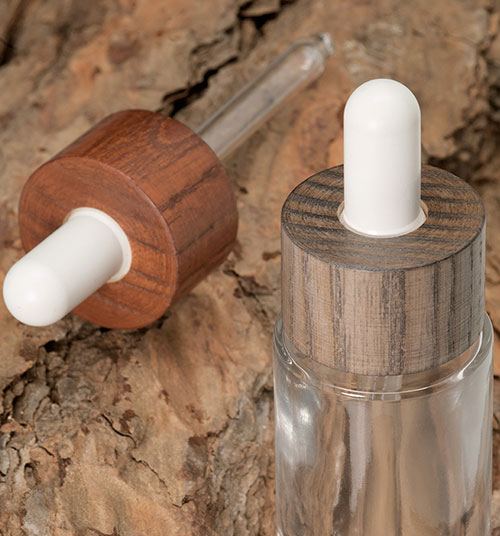
- Wood: wooden caps and collars that add a natural, tactile finish, especially suited to organic and botanical brands.
Virospack’s range of droppers with PCR, bio-based and wood options allows brands to choose the lower-impact option that best fits their identity, without changing the dosing gesture their consumers know.
The wiper also plays a role in sustainability, even though it is rarely mentioned. A wiper is the insert placed in the neck of the bottle that cleans the outside of the pipette as it is withdrawn. Unlike a simple stopper, which only seals the opening, the wiper controls how much product leaves the bottle with each use. A well-fitted wiper means more accurate doses, fewer drips on the neck and label and less formula wasted over the life of the product.
An important point of transparency: a complete pack made of a glass bottle and a plastic dropper is not mono-material as a whole. What makes it eco-friendly is that each component is made of a single material and can be easily separated by the consumer, so glass and plastic each go to the right recycling stream.
Droppers Catalogue
Discover our full range of droppers catalogue
Design principles for premium eco-friendly skincare packaging
Choosing sustainable components is only half the work. The other half is designing the pack so that sustainability and luxury reinforce each other. These principles help.
1. Reduce layers, not luxury
Every extra material, coating or component adds complexity to recycling. The most elegant packs are often the simplest: a beautiful glass bottle, a refined dropper and a precise print. Instead of adding elements to signal value, invest in the quality of the few elements you keep.
2. Let the glass and the formula do the work
Clear, uncoated glass is one of the simplest packaging materials to recycle, and it has a design advantage: it shows the product. The Haielle Active Botanical Concentrate, part of our showroom, is a good illustration. The clear glass bottle lets the golden color of the botanical oil become the main visual element of the pack. A classic dropper with a white bulb and a silver collar and a discreet print complete the design. There is no need for heavy coatings: the formula itself provides the color and the premium feel.
3. Make your commitments visible on a clean design
Brands with certified natural or organic formulas need space on the pack to communicate it. The A-Derma Biology Hyalu serum, also featured in our showroom, combines a clear glass bottle with a white dropper and a fresh green label that carries its organic certification and natural-origin claims. The minimal design leaves room for these messages and makes the product’s positioning immediately readable, proving that a dermocosmetic pack can look clean, credible and sustainable at the same time.
4. Choose decoration processes, not just decoration effects
Premium finishes do not have to come with a high environmental cost. Electrostatic lacquering with water-based paints can produce opaque or translucent colors in gloss or matte, and spray lacquering can create gradients and pearlescent effects. Screen printing, pad printing and hot stamping add branding with precision, and metallization can be concentrated on the collar or cap, where it has the greatest visual impact. Asking how a finish is applied is as important as choosing what it looks like.
5. Design for disassembly from day one
If a consumer cannot separate the dropper from the bottle easily, the best materials in the world will not be recycled correctly. Plan simple, intuitive separation, and explain it on the secondary packaging or the brand’s website.
6. Design the bottle to be kept
A pack that is beautiful enough to keep is a pack that can be refilled. Heavier moulded glass, a refined dropper and durable decoration make the bottle an object the consumer wants to reuse. That makes refill strategies more credible and extends the life of every unit produced.

Matching eco-friendly packaging options to your skincare formula
Formula | Recommended eco-friendly solution | Design note |
Facial oils and botanical concentrates | Clear or tinted glass with a lower-impact dropper and well-fitted wiper | Let the color of the oil be part of the design |
Light-sensitive serums (vitamin C, retinoids) | Amber or tinted glass with dropper | Protecting the formula avoids waste caused by degradation |
Organic or natural-certified skincare | Clear glass, wood or bio-based components | Keep the label clean to communicate certifications |
High-value anti-aging serums | Moulded glass with last-drop system and refill-ready design | Weight and finish make the bottle worth keeping |
Concentrates, ampoules and travel sizes | Tubular glass with mono-material dropper | Light, clear and precise |
Common mistakes that compromise both sustainability and design
- Choosing a material for its image rather than its performance: a pack that does not protect the formula causes product waste, which undermines any environmental claim.
- Adding “eco” elements as decoration: extra paper sleeves, tags or mixed-material inserts can make a pack harder to recycle.
- Overlooking the dropper: brands often focus on the bottle and leave the closure as a standard part, when it is where most of the improvement is possible.
- Making claims you cannot support: words like “recyclable” or “refillable” should be backed by the real design of the pack.
- Ignoring dosing accuracy: a dropper that drips or doses inaccurately wastes formula with every use.
How Virospack approaches eco-friendly skincare packaging
For 70 years, Virospack has specialized in droppers and glass packaging for the beauty industry, manufacturing glass, rubber, pipettes, plastic components and decoration in its own facilities. This vertical integration makes it possible to apply sustainability at every stage, from the composition of each component to the decoration process and final assembly.
Virospack has held an EcoVadis Gold Medal for four consecutive years and works under ISO-based management systems with an EMAS environmental declaration. Its sustainability roadmap includes concrete targets for 2030: reducing water consumption in production by 10%, industrial waste by 10%, warehouse electricity consumption by 7%, volatile organic compound emissions by 20% compared to 2023 levels and Scope 1 and 3 CO2 emissions by 15%.
For brands, this means eco-friendly skincare packaging that does not depend on a single “green” product, but on a complete system: durable glass, lower-impact droppers and decoration designed to deliver a premium result.
Frequently asked questions about eco-friendly skincare packaging
What is eco-friendly skincare packaging?
It is packaging designed to reduce environmental impact throughout its life cycle: lower-impact materials, durability, protection of the formula to avoid waste, and easy recycling or refilling. In premium skincare, it is usually based on glass bottles with lower-impact droppers.
What is the most eco-friendly packaging for skincare?
For liquid skincare such as serums and oils, glass is one of the most sustainable choices because it is inert, durable, refillable and recyclable. Combined with a mono-material, PCR, bio-based or wood dropper, it offers one of the best balances between sustainability and premium design.
Can sustainable packaging look luxurious?
Yes. Glass, refined droppers and water-based decoration offer the same premium finishes as conventional packaging. The most effective eco choices, such as the composition of the dropper or the decoration process, are invisible to the consumer.
Is a glass bottle with a dropper recyclable?
The glass bottle is recyclable. The dropper should be separated before recycling because it is made of different materials. Mono-material droppers make this easier, as the whole dropper is made of a single plastic.
What is a mono-material dropper?
It is a dropper made entirely from one type of plastic, such as PP, instead of combining rubber, glass and different plastics. This makes it simpler to recycle. Virospack’s patented Eco Dropper is an example of this approach.
What does PCR mean in cosmetic packaging?
PCR stands for post-consumer recycled. It refers to material recovered from used products and reprocessed to make new packaging components, reducing the need for virgin material.
Are refillable skincare bottles worth it for premium brands?
Refillable glass bottles extend the life of the pack and can strengthen the relationship with the consumer. They work best when the bottle is designed to be kept, with durable decoration and a high-quality dropper.
Does eco-friendly packaging protect skincare formulas as well as conventional packaging?
It should. Protection is part of sustainability, because a formula that degrades is wasted. Glass offers excellent protection, and tinted or amber glass adds protection against light for sensitive actives.