

Eye Dropper Bottles: A Complete Guide to Choosing the Best Packaging for Cosmetic Formulas
In cosmetic packaging, eye dropper bottles are often perceived as simple containers. In reality, they are precision systems that directly influence how a formula behaves, how it is applied and how it is perceived.
Choosing the right eye dropper bottle is not a matter of format. It is a matter of compatibility between the formula, the dispensing system and the user interaction.
When this alignment is correct, the product performs consistently. When it is not, variability appears immediately — in dosing, in texture and in user perception.

Table of Contents
What Are Eye Dropper Bottles and Why They Matter in Cosmetics
Eye dropper bottles are packaging systems designed to dispense liquids in controlled, progressive quantities using a pipette.
They are widely used in:
- serums
- facial oils
- treatments
- fluid foundations
Their relevance comes from one key factor: control.
Unlike pumps, which deliver fixed doses, eye dropper bottles allow the user to adjust the amount of product applied. This makes them particularly suitable for concentrated formulas where precision matters.
However, this flexibility also introduces complexity. The performance of the system depends on how well it is engineered.

How Eye Dropper Bottles Work: Understanding the System
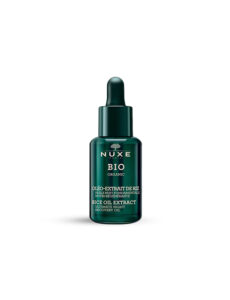
An eye dropper bottle is not just a bottle with a pipette. It is a system composed of three interdependent elements:
- the glass container
- the pipette
- the closure mechanism
When the dropper is pressed and released, liquid is drawn into the pipette. When pressed again, the liquid is released.
What seems simple is actually governed by several variables:
- internal bottle geometry
- pipette diameter and length
- air return inside the system
- viscosity of the formula
These factors determine:
- how much product is loaded
- how consistently it is released
- how the drop forms and detaches
A small variation in any of these elements can change the behaviour of the entire system.
Types of Eye Dropper Bottles Used in Cosmetic Packaging
Not all eye dropper bottles behave the same way, even if they look similar.
The most common distinction is between standard dropper and more controlled systems.
Standard droppers rely on user interaction. The amount of product drawn depends on how the pipette is pressed and released. This makes them flexible, but also introduces variability.
More advanced systems, such as push button droppers, regulate the dosing cycle internally. This reduces dependency on user pressure and improves consistency across applications.
Beyond the actuation system, pipette configuration plays a critical role.
Changes in:
- diameter
- tip shape
- length
affect how the product is loaded and released. These variations are essential when working with different viscosities.
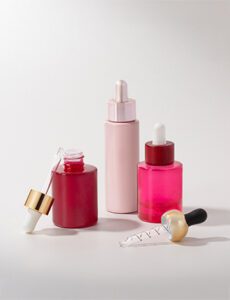
How to Choose the Right Eye Dropper Bottle for Your Formula
Selecting the right eye dropper bottle starts with understanding the formula.
Viscosity
Low-viscosity formulas require tighter control to avoid over-dispensing. High-viscosity formulas need wider flow paths to ensure proper loading.
The pipette must be calibrated accordingly.
Dosage Requirements
If the product requires precise, repeatable dosing, systems with controlled actuation provide better consistency.
If flexibility is more important, standard droppers may be more appropriate.
Application Method
Products applied drop by drop require stability and precision. Products applied more freely can tolerate variability.
Formula Sensitivity
Light-sensitive formulas benefit from tinted glass. Air-sensitive formulations require systems that minimize exposure.
The container must support these constraints.
How Glass Choice Affects Dropper Bottle Performance

Glass is not only a visual element. It affects how the system behaves.
- Tubular Glass blottles offer highly controlled internal dimensions. This improves consistency in dropper systems by stabilizing air exchange and liquid flow.
- Moulded Glass bottles allow more complex shapes and heavier structures. However, they require additional calibration to maintain internal consistency.
Choosing between them is not an aesthetic decision. It is a functional one.
Droppers Catalogue
Discover our full range of droppers catalogue
Common Mistakes When Selecting Eye Dropper Bottles
Many packaging issues originate from incorrect assumptions at the selection stage.
One of the most common mistakes is choosing a dropper based on appearance rather than behaviour. Two droppers may look identical but perform differently depending on their internal configuration.
Another frequent issue is ignoring the relationship between pipette and bottle geometry. If these elements are not aligned, inconsistencies appear in dosing.
Using the same container for different formulas without adjustment is also problematic. Even small differences in viscosity can change how the system behaves.
These errors often only become visible after production, when variability becomes difficult to correct.
How Eye Dropper Bottles Influence User Experience
The behaviour of an eye dropper bottle directly defines how the product is experienced in use.
Users do not evaluate packaging technically. They perceive it through interaction.
A dropper that fills consistently, releases the product cleanly and responds predictably creates a sense of control. That control is interpreted as quality.
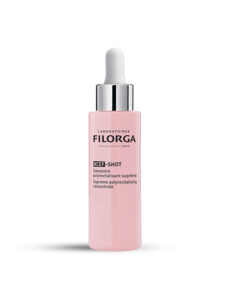
When this does not happen, the effect is immediate.
If the pipette draws different amounts each time, the user loses confidence in how much product is being applied. If the drop hesitates before detaching, or splits irregularly, the application feels imprecise. If air bubbles appear during loading, the system feels unstable.
These are not minor details. They shape how the product is perceived from the first use.
The key variables behind this experience are not visible:
- how quickly the pipette refills
- how stable the liquid remains inside it
- how the drop forms and detaches
- how consistent the system behaves across repeated uses
All of these depend on the relationship between the pipette, the bottle geometry and the formula itself.
At this level, user experience is not designed through form. It is defined through behaviour.
A system that performs consistently reinforces precision, control and reliability — all of which are essential for premium cosmetic products.
Why Custom Eye Dropper Bottles Are Becoming Standard
Standard dropper bottles were designed to work across a wide range of formulas. That flexibility was once an advantage. Today, it is a limitation.
Cosmetic formulations have evolved. They are no longer uniform in behaviour. Differences in viscosity, texture and sensitivity now require packaging systems that are precisely aligned with how the product performs.
A dropper that works well for a lightweight oil may behave inconsistently with a hybrid serum.
A system that delivers stable dosing for one formula may introduce variability in another.
This is why custom eye dropper bottles are becoming standard.
Customization is not about visual differentiation. It is about controlling how the system behaves:
- how the liquid is drawn into the pipette
- how consistently it is released
- how the system responds over repeated use
This requires adjusting the relationship between key elements:
- bottle geometry
- pipette configuration
- air and liquid flow inside the system
At this level, packaging is no longer selected from a catalogue. It is calibrated to the formula.
For brands, this shift has a direct implication.
Using a standard solution may appear efficient, but it often introduces variability that only becomes visible after launch. Custom systems reduce that risk by ensuring that performance is stable from the beginning.
As formulations become more complex, customization is no longer an added value.
It is becoming the baseline for reliable product performance.
FAQs About Eye Dropper Bottles
How do you choose the right eye dropper bottle for a cosmetic formula?
The selection depends primarily on how the formula behaves.
Viscosity, sensitivity to air or light, and dosing requirements all influence the system. The key is aligning the pipette configuration and bottle geometry with how the product needs to be dispensed.
A mismatch between formula and packaging often leads to inconsistent dosing or unstable performance.
Why do some droppers deliver inconsistent amounts of product?
In standard dropper systems, dosing depends on how the user presses and releases the pipette.
Variations in pressure, speed and immersion depth can change how much liquid is drawn and released. This is why some systems feel less consistent, especially with low-viscosity formulas.
More controlled systems reduce this variability by regulating the dosing cycle internally.
How does glass affect dropper bottle performance?
Glass influences both protection and behaviour.
Tinted glass can protect sensitive formulas from light exposure, while the internal geometry of the bottle affects air exchange and liquid movement.
This directly impacts dosing consistency.
Why are custom dropper bottles becoming more common?
As formulations become more complex, standard packaging often fails to deliver consistent performance.
Custom dropper bottles allow the system to be adapted to the formula, ensuring stable dosing and predictable behaviour across uses.
What are the most common mistakes when selecting dropper bottles?
The most common mistake is choosing based on appearance rather than performance.
Other issues include ignoring the relationship between pipette and bottle geometry, or using the same system for different formulas without adjustment.
These decisions often lead to inconsistencies that appear after production.