

Custom Cosmetic Containers in Action: Real Examples of Premium Beauty Packaging
In premium beauty, customization is not about making packaging look different. It is about making it behave differently.
The concept of custom cosmetic containers is often reduced to visual differentiation — a unique shape, a distinctive finish. But at high-end level, customization operates deeper. It defines how the product is dispensed, how it feels in use and how consistently it performs over time.
This is why the most advanced packaging is not visually radical. It is technically precise.
And that precision always emerges from the interaction between glass architecture, dispensing systems and component engineering, not from isolated design decisions.

Table of Contents
Customization Begins with the Formula, Not the Container
The first level of real customization appears when packaging is developed around how the formula behaves.
A product like Guerlain Abeille Royale Youth Watery Oil makes this explicit. It is not a conventional oil, but a hybrid structure with suspended micro-droplets. If the system is not controlled, the texture breaks and the product loses its identity.
To prevent this, the container must stabilize the way the liquid moves.
This is where Tubular Glass Bottles become particularly relevant. Their controlled internal geometry allows predictable air exchange and fluid behaviour, which is essential when working with dropper-based systems.
The pipette, in turn, cannot be generic. In standard dropper systems, variations in diameter, length and tip design determine how the product is loaded and released. In a formula like this, those variables define whether the texture remains intact or not.
Customization here is not visual. It is fluid control.

When Customization Defines Application

In some cases, customization is not driven by the formula itself, but by how the product is meant to be applied.
With Giorgio Armani Maestro Fusion Makeup SPF 15, the choice of a dropper instead of a pump completely transforms the application ritual.
The formula is extremely fluid. A pump would deliver too much product in a single actuation, breaking the lightweight, buildable nature of the foundation. The dropper, on the other hand, allows progressive application and finer control.
However, this decision introduces a different constraint.
A standard dropper system, based on a pipette, depends entirely on how the user presses and releases it. This means that dosing is not mechanically controlled, but influenced by user behaviour:
- how much pressure is applied
- how quickly the pipette is released
- how deep it is inserted into the liquid
As a result, the amount of product drawn and released can vary from one use to another.
This is not necessarily a flaw. It is a trade-off.
The system prioritizes flexibility and control in the hands of the user, but sacrifices repeatability.
Customization as Control of Perception
In premium skincare, precision is not only functional. It is perceptual.
With Estée Lauder Nutritious Essence Oil, the user expects every application to feel identical. That perception of control is built through repetition.
The elasticity of the dropper, the speed at which it refills and the way the drop detaches all contribute to that experience.
Standard droppers can deliver product. But only calibrated systems — where the pipette is tuned to the viscosity and the bottle geometry — can maintain consistency across uses.
This is where customization becomes invisible but critical. It is not about adding complexity, but about removing variability.

Adapting the Same Logic to Different Categories
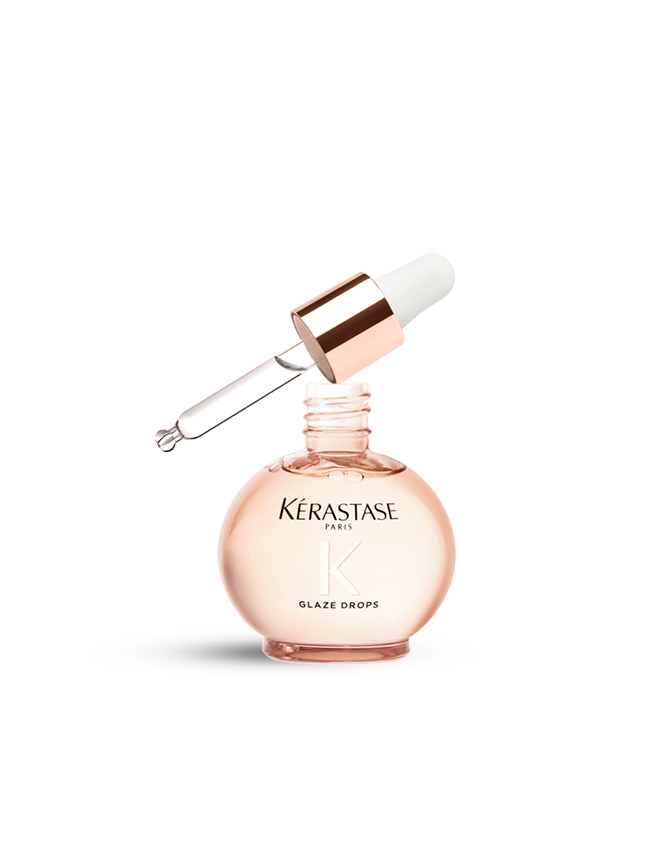
Customization does not mean reinventing packaging. It means recalibrating how the system behaves.
In haircare, products such as Kérastase Glaze Drops operate under a completely different rhythm compared to skincare.
The product is not applied drop by drop with precision. It is distributed through movement — across lengths, mid-sections or ends of the hair. This changes the requirements of the container entirely.
The use of a standard dropper system (pipette) in this context is not about precision dosing, but about controlled flexibility.
The user is not expected to extract an exact quantity. Instead, the dropper allows:
- variable dosing depending on hair length
- quick adjustment during application
- intuitive interaction without strict control
However, this also means that the system does not enforce consistency.
The amount of product loaded into the pipette depends on user interaction, and the release is influenced by angle, speed and pressure. In a haircare context, this variability is acceptable — and even desirable — because the application itself is less rigid.
From a packaging engineering perspective, this highlights an important point:
The same dropper architecture can serve completely different purposes depending on how it is tuned and how the product is used.
In skincare, it supports precision.
In haircare, it supports adaptability.
And that difference is not defined by the visible format, but by how the system behaves in real conditions.
When Viscosity Defines the Container
Viscosity is one of the most critical variables in custom cosmetic containers.
Products like Biotherm Blue Therapy Serum sit in a narrow range where the liquid is neither fully fluid nor dense.
If the system is not tuned correctly, instability appears.
If the pipette is too restrictive, the product loads unevenly. If it is too open, the drop becomes uncontrolled. If air exchange is not balanced, bubbles disrupt dosing.
This is why different pipette configurations within dropper systems exist. They are not variations for design, but adjustments to how the liquid behaves inside the container.
The container is effectively calibrated to the formula.

When Standard Droppers Are the Right Choice

With Bobbi Brown Intensive Skin Serum Foundation SPF 40, the packaging has to balance two logics: skincare precision and makeup usability.
The use of a standard dropper (pipette) is intentional.
It allows controlled, progressive dosing — aligned with its treatment positioning — but keeps flexibility for daily use. The amount dispensed adapts to how the user presses and releases the pipette.
There is no fixed dose. And that is the point.
In this case, customization is not about maximizing precision, but about allowing the product to behave differently depending on how it is used.
When Customization Reaches Luxury-Level Precision
At the highest level, customization becomes almost invisible.
In Cartier Gouttes de Parfum Concentré, the objective is not to showcase engineering, but to eliminate friction.
The drop forms perfectly. The closure responds smoothly. The system behaves identically every time.
This level of control is typically achieved through moulded glass bottles, where weight, presence and geometry are precisely defined, combined with high-precision dropper systems.
At this level, every variable is aligned.
Customization is no longer about adding features. It is about controlling the entire system.

Droppers Catalogue
Discover our full range of droppers catalogue
What These Examples Reveal About Custom Cosmetic Containers
Across all these products, the same principle appears.
Customization is not applied at the surface. It is built into the behaviour of the system.
It emerges from:
- the relationship between bottle and pipette
- the control of air and liquid flow
- the calibration of dosing behaviour
- the adaptation to how the product is used
This is why custom cosmetic containers cannot be standardized.
They are defined by how the product moves, not by how the container looks.
The Role of Virospack in This Type of Packaging
What enables this level of customization is not offering more options. It is controlling how all elements interact.
Virospack develops packaging systems where tubular and moulded glass bottles, standard and push button droppers, pipette configurations and structural solutions like metal shell bottles are not independent elements, but parts of a unified system.
This allows packaging to be tuned to specific formulas and usage conditions, ensuring consistency across units and across time.
At this level, packaging is not selected.
It is engineered.
FAQs About Custom Cosmetic Containers
What are custom cosmetic containers?
Custom cosmetic containers are packaging systems designed to match the behaviour of a specific formula and its method of application.
This goes beyond shape or decoration. It includes how the product is dispensed, how consistently it performs and how the user interacts with it.
When should a brand choose a dropper instead of a pump?
A dropper is typically used when the formula requires controlled, progressive dosing.
This is common in oils, serums or fluid foundations, where applying small amounts is critical. Pumps, by contrast, deliver fixed doses and are better suited for creams or higher-viscosity products.
Are all droppers the same?
No.
Even within standard droppers, variations in pipette length, diameter and tip shape affect how the product is loaded and released.
This is why dropper systems are often calibrated to the viscosity and behaviour of the formula.
What is the difference between standard droppers and push button droppers?
Standard droppers depend on how the user presses and releases the pipette, which introduces variability.
Push button droppers regulate the dosing internally, providing more consistent and repeatable output regardless of user interaction.
How does glass type affect cosmetic packaging performance?
Glass is not only aesthetic. Its internal geometry affects how air enters the bottle and how the liquid moves.
For example, tubular glass offers more controlled internal dimensions, which improves consistency in dropper-based systems.
Why is consistency important in premium cosmetic packaging?
In high-end products, users expect the same experience every time they use the product.
If dosing, texture or flow vary between uses, the product feels less precise and the perceived quality decreases.
Consistency is a key part of premium positioning.
Can the same container be used for different formulas?
Not always.
Even if two formulas look similar, differences in viscosity or composition can change how they behave inside the container.
This is why custom cosmetic containers are often adapted to each specific product.