

Glass Perfume Bottles: Premium Glass and Decoration Techniques by Virospack
In the fragrance industry, glass perfume bottles are not simply packaging components — they are structural expressions of brand identity. Long before a consumer experiences the scent, they experience the bottle: its weight, its proportions, the way light travels through the glass, and how it rests in the hand.
A premium perfume bottle must achieve a complex balance. It must preserve an alcohol-based formula that contains volatile aromatic compounds. It must integrate flawlessly with atomizer systems that demand mechanical precision. And at the same time, it must embody luxury through material depth, visual clarity, and architectural coherence.
For this reason, developing high-end glass perfume bottles requires more than aesthetic sensibility. It requires engineering discipline, manufacturing accuracy, and decorative mastery applied directly to glass.
Three structural pillars define this process:
- Glass architecture (tubular or moulded)
- Precision production and integration
- Advanced decoration applied at material level
Each of these elements influences not only appearance, but also tactile perception, performance stability, and long-term brand coherence.

Table of Contents
Glass Architecture in Glass Perfume Bottles: Tubular vs Moulded
When designing premium glass perfume bottles, the decision between tubular glass and moulded glass is one of the most consequential technical choices in the entire development process.
This decision shapes the bottle’s geometry, its mass distribution, the way decoration behaves on the surface, and even how the consumer subconsciously interprets the fragrance’s positioning.
It is not simply a manufacturing choice — it is a strategic architectural decision.

Tubular Glass: Structural Precision and Industrial Control
Tubular glass is produced from drawn glass tubes that are subsequently cut, heated, and shaped into finished containers. Because the material originates from uniform tubing, it offers exceptional dimensional control.
This precision translates into perfectly aligned cylindrical forms, consistent wall thickness, and extremely stable tolerances across large production volumes.
In practice, this means that tubular glass bottles offer:
- Geometric symmetry that supports minimalist design languages
- Reliable neck finish accuracy for atomizer integration
- Superior decoration alignment due to cylindrical precision
- Lightweight structures that still convey refinement
Tubular glass is particularly suited for contemporary fragrance collections where clarity, precision, and restrained elegance define the aesthetic. Brands operating in modern luxury or technical niche segments often favor tubular architecture because it reinforces clean visual codes and production reliability.
From a manufacturing perspective, tubular glass also facilitates scalability. The consistency of its geometry allows decoration processes such as silk-screen printing or metallic hot stamping to be executed with exceptional repeatability.
In fragrance packaging where typographic alignment and branding precision matter, tubular glass provides the structural foundation for exact decorative application.
Moulded Glass: Sculptural Freedom and Sensory Weight
In contrast, moulded glass is created by injecting molten glass into custom mould cavities. This process allows the bottle to move beyond cylindrical symmetry and into fully sculptural territory.
In contrast, moulded glass is created by injecting molten glass into custom mould cavities. This process allows the bottle to move beyond cylindrical symmetry and into fully sculptural territory.
Moulded glass enables designers to manipulate:
- Base thickness
- Wall distribution
- Curvature
- Faceting
- Structural relief
The result is architectural freedom.
Where tubular glass emphasizes precision and restraint, moulded glass emphasizes mass, depth, and presence.
A moulded glass perfume bottle can carry substantial weight in the base, creating a lower center of gravity and a tactile sensation associated with permanence and luxury. The added mass enhances perceived value — an important psychological factor in high-end fragrance positioning.
Light behaves differently in moulded glass. Variations in thickness create optical depth and internal reflections that enhance the visual richness of the fragrance color itself. In sculptural formats, the bottle becomes a display object as much as a container.
Luxury houses such as Cartier demonstrate how moulded glass can function as a brand signature. The bottle is not secondary to the scent — it is part of the storytelling architecture.

Why the Distinction Between Tubular and Moulded Truly Matters
The choice between tubular and moulded glass directly affects:
- Perceived weight and in-hand sensation
- Optical depth and light interaction
- Decoration strategy feasibility
- Production complexity
- Cost structure and scalability
For example, while tubular glass offers decoration precision due to its cylindrical geometry, moulded glass may require adaptive printing strategies because curved or faceted surfaces change how ink and metallic layers adhere and reflect.
Similarly, moulded glass introduces additional engineering considerations for neck finish precision, as variable wall thickness must be managed to maintain atomizer compatibility.
For brands operating across multiple collections, combining both technologies strategically allows architectural differentiation while maintaining portfolio coherence.
How to Strategically Choose the Right Architecture
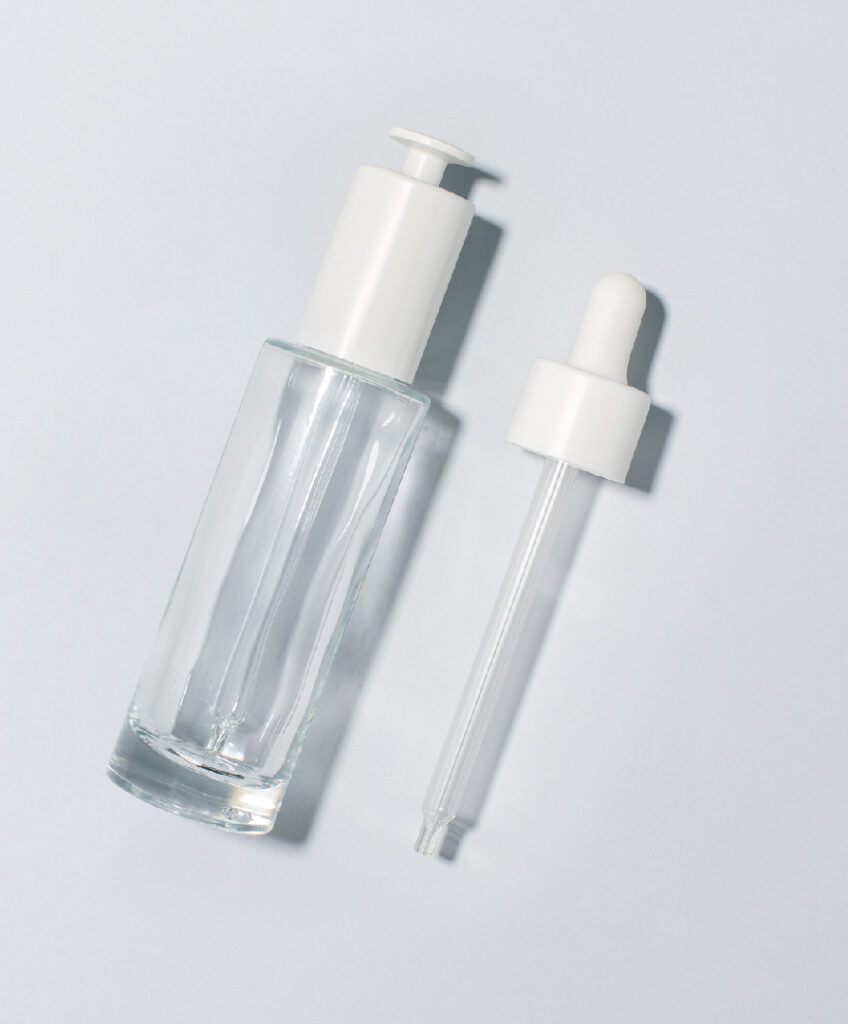
Many high-performance skincare formulas are developed to work within a narrow dosage range. Too little reduces efficacy; too much can overwhelm the skin. Dropper dispensing addresses this challenge by allowing controlled, incremental application.
Selecting between tubular and moulded glass perfume bottles should begin with brand architecture and product hierarchy.
If the fragrance line prioritizes technical refinement, geometric discipline, and consistent scalability, tubular glass offers structural alignment.
If the objective is to create a hero object — a sculptural asset that communicates heritage, exclusivity, or artistic depth — moulded glass provides the design freedom necessary to achieve that impact.
The decision should not be aesthetic alone. It should consider:
- Target market segment
- Expected production volumes
- Long-term SKU expansion
- Decoration complexity
- Atomizer integration requirements
Glass perfume bottles are long-term investments in brand architecture. Their structural decisions influence future collections and manufacturing ecosystems.

Premium Decoration Techniques: Beyond Surface Branding
In fragrance packaging, decoration is not ornamental. It is material communication.
Decoration applied directly to glass must interact with:
- Surface curvature
- Glass thickness
- Light transmission
- Ink adhesion characteristics
Advanced techniques include ultra-fine silk-screen printing for high-definition branding, metallic hot stamping that adds reflective contrast, gradient lacquering that introduces color transitions, and frosted finishes that soften light refraction.
Decoration behaves differently on tubular versus moulded glass. Cylindrical surfaces allow precise registration of metallic layers. Sculptural forms demand calibrated printing parameters to preserve visual integrity.
Refined finishes visible in L’Occitane illustrate how subtle decoration enhances luxury without masking structural clarity.
High-end fragrance decoration is successful when it enhances the architectural identity of the glass rather than overwhelming it.
Engineering Integration: Glass and Atomizer as a Unified System
Modern glass perfume bottles are engineered ecosystems. The glass body must integrate flawlessly with:
- Crimped or screw-on atomizers
- Decorative collars
- Overcaps
- Dip tubes
- Internal sealing components
Neck finish tolerances are critical. Micrometric deviations can affect crimping pressure, spray consistency, and long-term evaporation rates.
- Proper engineering ensures:
- Stable atomization over product lifespan
- Controlled evaporation
- Transport durability
- Uniform spray pattern
Glass perfume bottles must be conceived as dispensing architectures, not standalone decorative vessels.
Droppers Catalogue
Discover our full range of droppers catalogue
Why Glass Remains the Premium Standard
Despite innovation in alternative materials, glass continues to dominate fragrance packaging for fundamental reasons.
It is chemically inert, meaning it does not interact with alcohol-based perfume formulas. It provides optical clarity that enhances visual depth. It supports advanced decoration without structural compromise. And it carries centuries of association with craftsmanship and permanence.
Unlike plastic or hybrid materials, glass perfume bottles offer both technical stability and emotional resonance — a dual advantage that defines luxury packaging.
Glass Perfume Bottles as Long-Term Brand Assets
In perfumery, the bottle is not disposable. It becomes part of the consumer’s environment — displayed on dressers, photographed in campaigns, remembered long after the fragrance is gone.
Geometry, mass, surface finish, and decoration create emotional imprint.
By combining tubular precision or moulded sculptural depth with advanced decoration and integrated mechanical engineering, Virospack develops glass perfume bottles that function not merely as containers, but as strategic brand assets.
- They preserve the formula.
- They express identity.
- They endure beyond the first spray.

Frequently Asked Questions About Glass Perfume Bottles
Why are glass bottles preferred for premium fragrances?
Glass bottles are preferred because glass is inert and does not interact with fragrance formulas. It preserves scent integrity while offering clarity, weight, and visual depth that reinforce the perception of luxury and craftsmanship.
What types of glass are used in high-end perfume bottles?
High-end glass perfume bottles often use premium flint glass or specially formulated cosmetic glass. These materials provide excellent transparency, consistency, and compatibility with advanced decoration techniques such as silk-screen printing and hot stamping.
How does bottle design influence the perception of a fragrance?
The shape, thickness, and balance of glass perfume bottles influence how a fragrance is perceived before it is even smelled. Sculpted forms, heavier bases, and refined proportions communicate quality, exclusivity, and permanence.
What decoration techniques are commonly used on glass perfume bottles?
Common decoration techniques include fine silk-screen printing, metallic hot stamping, lacquering, frosting, and selective matte finishes. These techniques enhance visual contrast and allow brands to express identity without compromising glass quality.
Can glass perfume bottles be customized for luxury brands?
Yes. Glass perfume bottles can be customized in terms of shape, glass finish, decoration, and component integration. Customization allows luxury brands to create distinctive packaging aligned with their fragrance concept and brand storytelling.
Are glass perfume bottles suitable for oils and concentrated fragrances?
Absolutely. Glass perfume bottles are well suited for oils and concentrated fragrances because glass does not absorb or alter scent compounds. Combined with precise dispensing systems, they help maintain fragrance performance over time.
How important is consistency in glass perfume bottle production?
Consistency is critical in luxury fragrance packaging. Uniform glass quality, decoration accuracy, and color consistency ensure that every glass perfume bottle meets brand standards and delivers a coherent experience across collections.
Why does packaging expertise matter in glass perfume bottle development?
Expertise ensures that glass selection, bottle design, and decoration techniques work together seamlessly. Professional packaging development guarantees durability, visual precision, and scalability while maintaining the premium positioning of glass perfume bottles.