Dropper Caps: Types, Mechanisms and How to Choose the Right Closure for Your Bottle
A dropper cap is a closure that seals a bottle and dispenses its contents drop by drop. It combines three elements in one piece: a collar that screws or clips onto the bottle neck, a mechanism that draws the liquid up (a rubber bulb, a push button or another system) and a pipette that holds and releases the dose. In beauty, dropper caps are the standard closure for serums, facial oils, concentrates and other liquid formulas used in small, precise amounts.
Choosing the right dropper cap comes down to five questions: which mechanism suits the product, which neck finish fits the bottle, how much product each dose should deliver, which materials are compatible with the formula and how the cap should look. This guide answers all five.
Key takeaways
- The main types of dropper caps for beauty are classic bulb droppers, push button droppers, magnetic droppers and two-component systems.
- A dropper cap only fits a bottle with the same neck finish, written as two numbers such as 18/415 (diameter in millimeters / thread style).
- The dose per fill depends on the mechanism and the pipette, and ranges from a fraction of a milliliter to more than one milliliter.
- The bulb, collar and pipette must be compatible with the formula, especially with oils and active ingredients.
- The collar is the most visible part of the cap and the main surface for decoration.
Table of Contents
Anatomy of a dropper cap

Part | Function | Common options |
Collar (cap) | Screws or clips onto the neck, seals the bottle and carries most of the design | PP, urea, PCR, bio-based materials, wood; metallized, lacquered or metal overshell finishes |
Bulb or push button | Creates the vacuum that draws the liquid into the pipette | Rubber or TPE bulbs; push buttons in different shapes |
Pipette | Holds the liquid and releases it drop by drop | Glass or plastic, straight or with a shaped tip, length adapted to the bottle |
Wiper | Insert in the bottle neck that removes excess liquid from the outside of the pipette | Sized to the pipette diameter and the viscosity of the formula |
The wiper is technically part of the bottle rather than the cap, but it works as a system with the pipette: without it, product runs down the outside of the pipette and drips onto the neck. It is different from a stopper, which only seals an opening.
Types of dropper caps
1. Classic bulb dropper caps
The most common type. The user squeezes a rubber or TPE bulb, inserts the pipette into the liquid and releases the bulb to draw the product up. A second squeeze releases it drop by drop. Bulb droppers are intuitive, versatile and suit most serums, oils and lotions. The bulb material matters: natural rubber, nitrile and butyl behave differently in contact with oils and actives, while TPE offers an alternative for formulas that require it.
2. Push button dropper caps
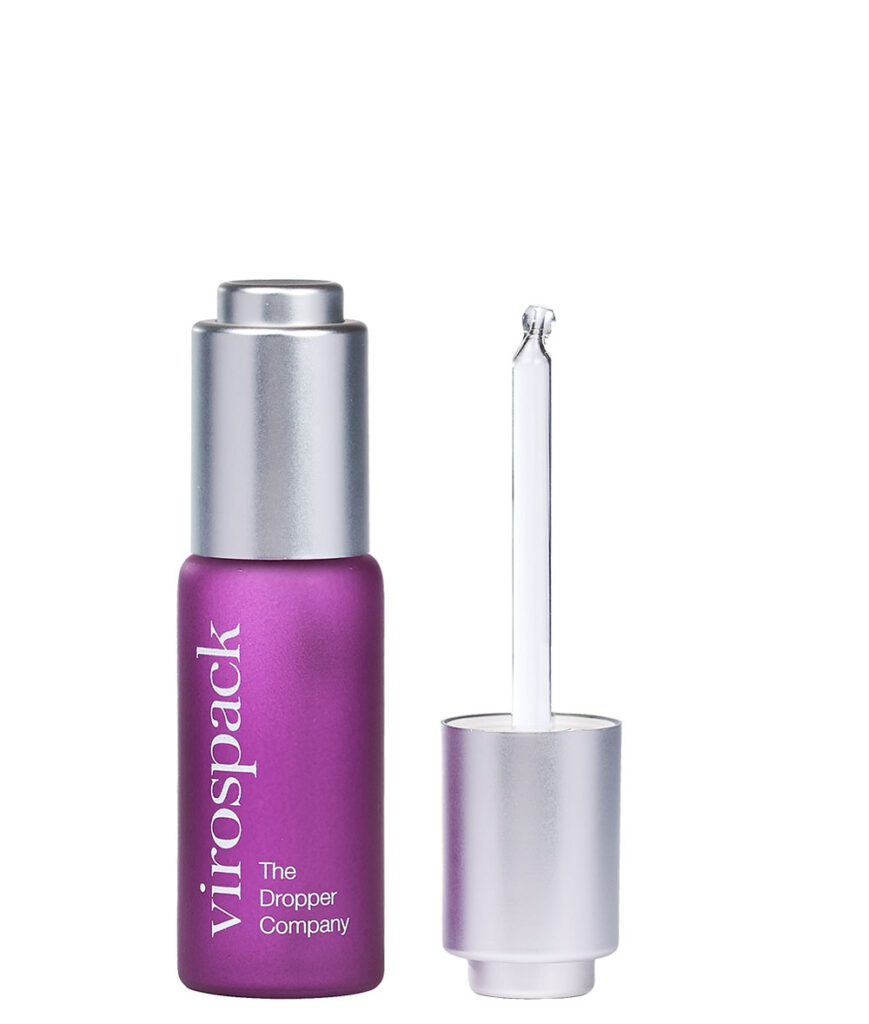
In a push button dropper, the bulb is hidden under a rigid button. Pressing the button loads the pipette in a single, repeatable movement, without the need to squeeze and release by hand. The result is a more precise, technical gesture and a cleaner silhouette, which is why push button droppers are common in high-end skincare. Virospack’s push button droppers are available with convex, concave, flat and syringe-style buttons, and with optional metal overshells.
The Algenist Genius Liquid Collagen, featured in our showroom, shows how far this format can be taken in design terms: a tall aqua overshell with a metallic finish on a clear glass bottle, topped by a slim plunger-style push button that makes the application gesture feel almost clinical. The cap itself becomes the most recognizable part of the product.
3. Magnetic dropper caps
A magnetic dropper closes the bottle with a magnetic mechanism instead of a thread. Virospack’s magnetic droppers are made of two pieces, a dropper and a clip-on embellisher, and provide a leak-free seal with a satisfying, tactile closing gesture. They are a premium option for brands that want the act of opening and closing the bottle to become part of the experience.
4. Two-component dropper systems
Some formulas must be kept in two separate parts until first use, for example a powder and a liquid, or two liquids that are mixed at the moment of activation. Two-component systems such as Duo Mix include a reservoir in the cap that releases its content into the bottle when the consumer activates it. They are often used for vitamin C and other actives that are most effective when freshly prepared.
5. Orifice reducer caps (for comparison)
Not every “dropper” uses a pipette. An orifice reducer is a small plastic insert pressed into the bottle neck with a narrow opening: the user tips the bottle and the liquid comes out drop by drop. It is common for essential oils and very fluid liquids, but it offers less control over the dose and a less premium experience than a pipette dropper, so serums and facial oils almost always use pipette dropper caps.
Type | How it works | Best for | Experience |
Classic bulb | Squeeze and release a bulb | Serums, oils, lotions | Intuitive, manual control |
Push button | Press a button to load the pipette | High-end serums and treatments | Precise, repeatable, technical |
Magnetic | Magnetic closure instead of a thread | Premium skincare | Tactile, leak-free, distinctive |
Two-component | Reservoir mixes two parts at first use | Vitamin C and freshly activated actives | Ritual of activation |
Orifice reducer | Tip the bottle to release drops | Essential oils, very fluid liquids | Basic, less dose control |
Dropper cap sizes: how to know which cap fits your bottle
A dropper cap fits a bottle only if both share the same neck finish. Neck finishes are written as two numbers, for example 18/415:
- The first number is the diameter of the neck in millimeters (18 mm).
- The second number is the thread finish, which defines the height of the neck and the shape of the thread. The same diameter can come with different finishes, such as 400, 410 or 415.
An 18/410 cap and an 18/415 bottle have the same diameter but a different finish, so they will not close properly. Always check both numbers.
Virospack’s range of droppers covers the most common neck finishes in beauty, including 13/415, 15/415, 18/400, 18/410, 18/415, 20/400, 20/410, 20/415, 22/410, 22/415, 24/410 and 28/410, as well as European “Europa” neck finishes. Beyond the neck, two other measurements must match the bottle:
- Pipette length: the pipette should reach close to the bottom of the bottle without touching it, so the consumer can use the product until the end.
- Dose per fill: each squeeze or press loads a specific volume. Depending on the dropper model, this ranges from around 0.12 mL to 1.6 mL per fill. If you want to understand how this translates into everyday use, see our guide on how many mL are in a dropper.

Droppers Catalogue
Discover our full range of droppers catalogue
Materials: matching the dropper cap to the formula
Every part of a dropper cap is in contact with the product or with the consumer, so materials must be chosen with the formula in mind:
- Bulb: rubber compounds (natural rubber, nitrile, butyl) and TPE each react differently to oils, alcohol and actives. An incompatible bulb can swell, harden or contaminate the formula. Virospack formulates and vulcanizes its own rubber, so the compound can be adapted to each project.
- Pipette: glass is inert and the reference for skincare; plastic is lighter and suits some formats. The tip shape and inner diameter determine the size of each drop.
- Collar: PP is light and versatile; urea offers weight and a premium feel; PCR, bio-based and wood collars reduce environmental impact.
Whatever the materials, the final dropper cap should always be tested with the real formula, not just with water, to confirm stability, sealing and drop formation.
Designing the dropper cap: where the brand shows
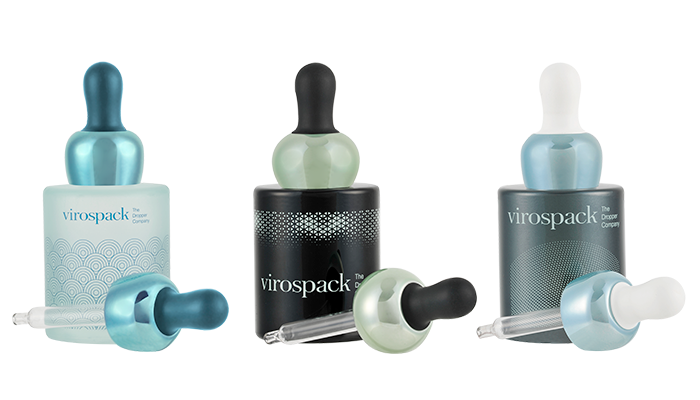
On the shelf, the cap is often the most visible part of a dropper bottle. Metallization, lacquering, hot stamping, screen printing, ribbed textures and metal overshells allow brands to turn a functional closure into a signature element.
The L’Oréal Paris Bright Reveal serum in our showroom is a good example of how a simple decision on the cap can carry the brand: a classic white bulb dropper with a metallized teal collar that matches the color of the label on a white bottle. The collar ties the whole pack together and makes the product recognizable from a distance, without any complex shape or extra component.
How to choose the right dropper cap: a checklist
- Formula: viscosity, light and air sensitivity, and compatibility with rubber or TPE.
- Dose: how many drops per application and how much product each fill should load.
- Mechanism: classic bulb for intuitive use, push button for precision, magnetic for a premium gesture, two-component for freshly activated formulas.
- Neck finish: same diameter and thread style as the bottle.
- Pipette length: adapted to the height of the bottle.
- Materials: bulb, pipette and collar compatible with the formula and the brand’s sustainability goals.
- Design: collar finish, color and texture consistent with the rest of the range.
- Testing: sealing, dispensing and stability tests with the real formula before production.
Common dropper cap problems and how to avoid them
Problem | Most likely cause | Solution |
Leaks during transport | Neck finish mismatch or insufficient sealing | Match diameter and thread style; test sealing with the real formula |
Drips on the neck and label | No wiper, or a wiper that does not fit the pipette | Use a wiper sized to the pipette and the viscosity |
Product left at the bottom | Pipette too short | Adjust the pipette length to the bottle height |
Bulb swells, hardens or cracks | Bulb material not compatible with the formula | Choose a compatible rubber compound or TPE |
Inconsistent doses | Mechanism or pipette not suited to the viscosity | Adjust dose per fill, pipette tip or switch to a push button |

Why brands work with Virospack for dropper caps
Virospack has spent decades specializing in droppers for the beauty industry. Bulbs, pipettes, collars and decoration are produced in its own facilities: rubber is formulated and vulcanized in-house, pipettes are cut with laser technology and every dropper is assembled and inspected on automated lines with artificial vision. This control over each component is what makes it possible to adapt the mechanism, the dose and the design of a dropper cap to each formula and each brand.

Frequently asked questions about dropper caps
What is a dropper cap?
It is a closure that seals a bottle and dispenses its contents drop by drop. It combines a collar, a mechanism such as a bulb or push button, and a pipette.
Are dropper caps universal?
No. A dropper cap only fits bottles with the same neck finish, meaning the same diameter and thread style, for example 18/415. The pipette length must also suit the bottle height.
What is the difference between 18/410 and 18/415?
Both have an 18 mm diameter, but a different thread finish, which changes the height of the neck and the shape of the thread. A cap and a bottle with different finishes will not seal properly, so both numbers must match.
What size dropper cap do I need for a 30 mL bottle?
It depends on the bottle’s neck finish, not only on its capacity. 30 mL bottles are made with different necks, so check the neck finish specified for your bottle and choose a dropper cap with the same one and a pipette long enough for its height.
What is the difference between a bulb dropper and a push button dropper?
A bulb dropper is filled by squeezing and releasing a rubber bulb by hand. A push button dropper hides the bulb under a rigid button that loads the pipette with a single press, giving a more repeatable dose and a cleaner design.
Are glass or plastic pipettes better?
Glass pipettes are inert and the reference for serums and facial oils. Plastic pipettes are lighter and can suit some formats, but compatibility with the formula should always be tested.
Why does my dropper cap leak?
The most common causes are a neck finish that does not match the cap, a seal that is not suited to the formula or a missing or poorly fitted wiper. Matching the finish and testing with the real formula solves most leaks.
Can dropper caps be customized?
Yes. The collar, bulb or button, pipette and finishes can all be customized, with options such as metallization, lacquering, hot stamping, screen printing, textures and metal overshells.
Need help choosing the right dropper cap for your bottle and formula? Contact our team and we will help you find the right mechanism, size and finish.